

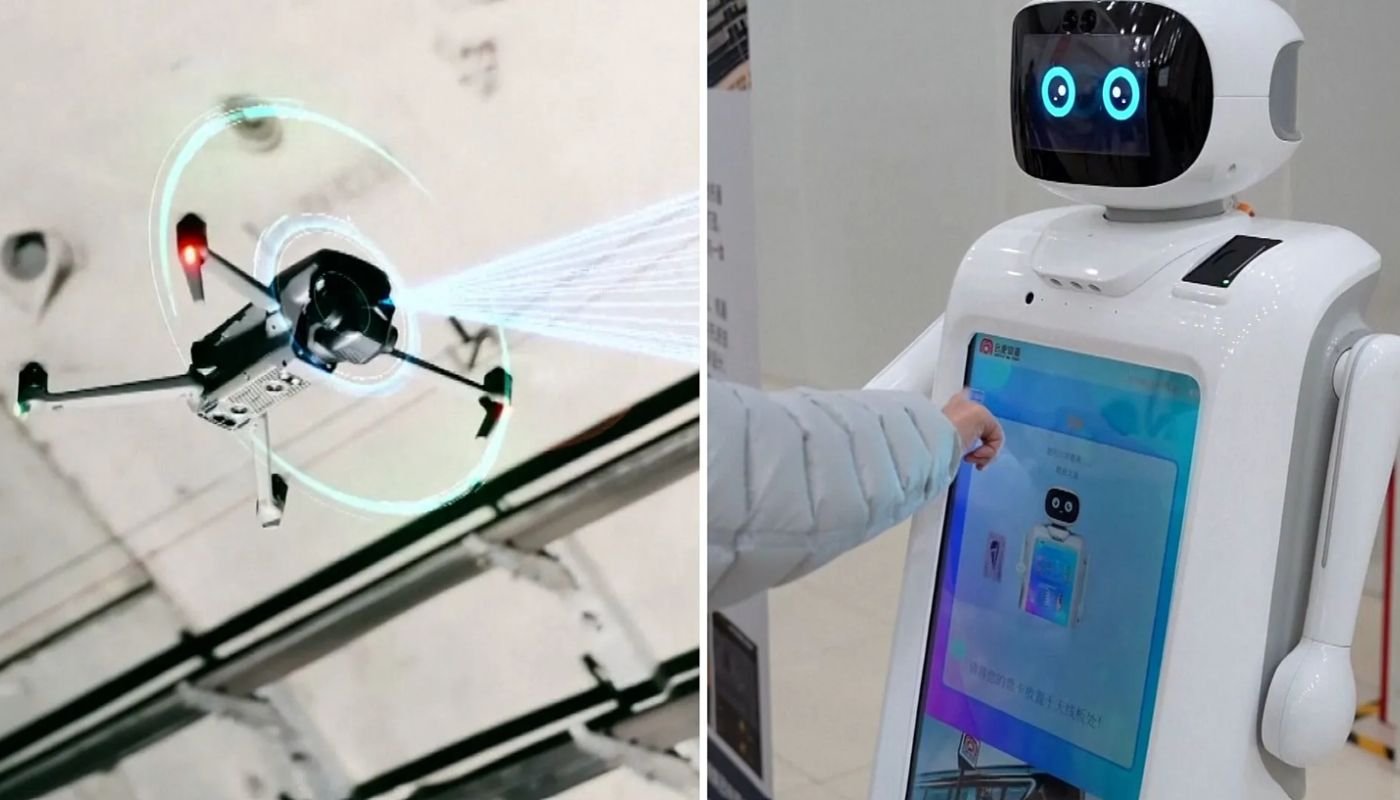
During the recent Spring Festival travel rush in February, commuters in Hefei were greeted with an unexpected sight: robot dogs patrolling train platforms, drones navigating through tunnels, and humanoid robots assisting passengers. This marks a significant milestone as local officials introduce what they describe as China’s first full-space "robot cluster" for rail transit.
The deployment occurred during one of the busiest travel seasons, showcasing a coordinated effort of autonomous machines, some equipped with legs, others on wheels, and some airborne, all operating in harmony with human employees. This initiative represents a pioneering step in integrating robotics into public transportation.
According to Dai Rong, the director of the Science and Education Center at Hefei Rail Transit, the project encompasses three main operational areas: intelligent services within stations, vehicle inspections, and tunnel inspections. Humanoid robots are specifically tasked with customer service, addressing passenger inquiries and providing directions, while robot dogs are designated for safety patrols across the platforms.
The Invisible Work Underground
The most remarkable functionalities of this robotic team occur out of sight of passengers. Autonomous robots are deployed within 1.5-meter maintenance trenches to conduct inspections beneath parked trains. Utilizing high-definition cameras and ultrasonic sensors, these robots can detect loose bolts or minor cracks in train wheels—tasks that previously demanded significant human labor and time.
This automated inspection process allows for immediate flagging of potential issues, thereby accelerating safety checks dramatically. The overarching goal is not to replace human workers but rather to alleviate the burdensome tasks from their responsibilities, allowing them to focus on more complex and passenger-centric duties.
“Our aim is to assist human staff, enhance work efficiency, and alleviate labor intensity, thereby empowering Hefei’s rail operations through advanced technology,” stated Dai Rong.
Advancing Robotic Intelligence
As the year progresses, the Hefei team is already investigating ways to enhance the intelligence of these robots. The current system is merely a starting point; future developments aim to equip the machines with advanced cognitive capabilities to navigate the unpredictable challenges of a busy metro environment more effectively.
“We aspire to build this platform utilizing large AI model technologies to provide these robotic dogs and drones with a more sophisticated central ‘brain’ for control. This advancement will enable them to identify and respond to various abnormal situations with greater precision,” shared Luo Lei, a senior supervisor at the Science and Education Center.
The Importance of Human Oversight
Despite the presence of drones and robotic dogs, human interaction remains a crucial element of the operation. Officials emphasize that these machines serve as assistants rather than replacements, focusing on repetitive, hazardous, or monotonous tasks to free human staff to engage more meaningfully with passengers and make complex decisions.
This approach underscores a broader trend in China’s rapid advancement in robotics, moving from mere performances to practical applications within public infrastructure. As the country continues to innovate, the integration of robotics and AI into everyday operations demonstrates a commitment to enhancing efficiency and safety in public transport.
Overall, the deployment of this sophisticated robotic system in Hefei is a testament to China's forward-thinking approach to public transportation and technology, setting a precedent for future developments in metro systems worldwide.
Source: eWEEK News