

Gemini Usage Surges Across Google Products
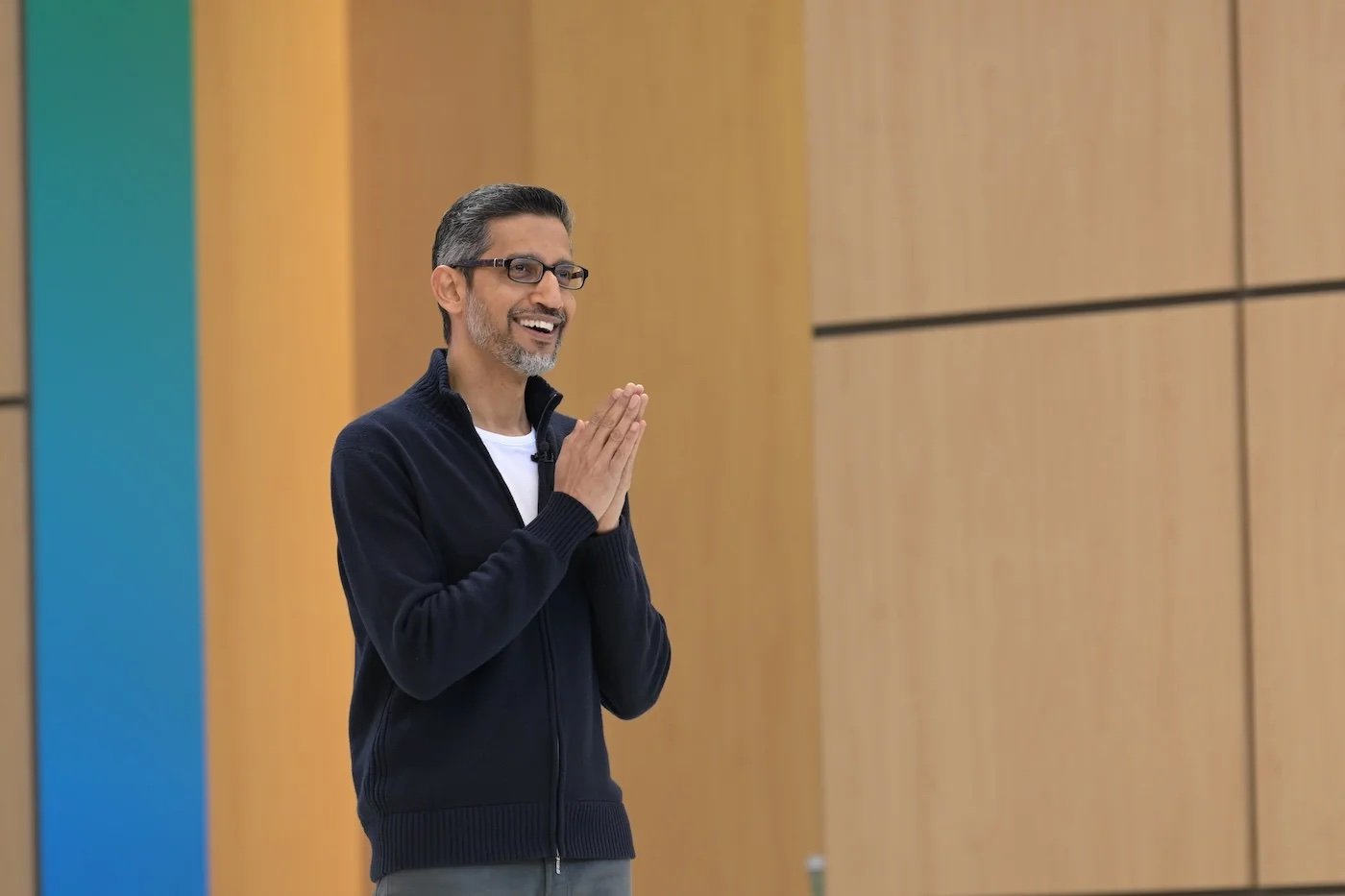
Google kicked off its annual I/O developer conference with a bold vision for the future of artificial intelligence. CEO Sundar Pichai declared the start of the company's "agentic Gemini era," emphasizing that AI is no longer just a feature but the central operating system across Google's entire product ecosystem. The keynote highlighted explosive growth in Gemini adoption, with monthly token processing soaring to over 3.2 quadrillion—a sevenfold increase year-over-year. More than 8.5 million developers now build with Gemini models monthly, and Google's APIs handle approximately 19 billion tokens per minute.
Pichai pointed to consumer-facing products as proof that AI is becoming mainstream. AI Overviews, which provide summarized answers directly in search results, now serve over 2.5 billion monthly active users. The Google Gemini app itself has crossed 900 million monthly active users, more than doubling from 400 million the previous year. Users have generated over 50 billion images using Google's Nano Banana image generation models, demonstrating the rapid adoption of generative AI tools in everyday tasks.
This surge reflects a broader trend in the tech industry, where AI is shifting from experimental to essential. Google's ability to embed Gemini into its most popular services—Search, Android, Workspace, and Chrome—gives it a distribution advantage that few competitors can match. The company is betting that seamless integration will keep users within its ecosystem, even as rivals like OpenAI and Microsoft push their own AI assistants.
Search Becomes More Conversational and More Agentic
A central theme of the keynote was the transformation of Google Search from a traditional keyword-based engine into an interactive AI companion. Pichai described the new Search as feeling "more like an ongoing conversation," with users asking longer, more complex questions that require nuanced understanding. To support this shift, Google announced several innovative features.
One standout is Ask YouTube, which allows users to query video content directly and jump to relevant segments. Rather than watching entire videos, users can ask specific questions like "How do I fix a leaky faucet?" and get a precise clip showing the solution. The feature is currently in testing and will roll out more broadly in the U.S. this summer. This capability leverages Gemini's multimodal understanding to parse video frames, audio, and text overlays.
Google also introduced information agents in Search—personalized AI agents that users can set up to continuously monitor topics, returning useful updates or even taking actions in the background. Pichai explained, "These are personalized AI agents you can set up to work in the background, 24/7, to find what you need at exactly the right moment, and help you take action." For example, a user could create an agent to track flight prices for an upcoming trip and automatically book when the price drops below a threshold. Search will soon generate dynamic layouts, interactive visuals, and persistent dashboards for long-running tasks, making the experience far richer than the classic blue-link results.
These changes represent Google's most ambitious overhaul of Search since its founding. By integrating agents that can act on behalf of users, Google is moving beyond information retrieval into task completion—a territory that could redefine how people interact with the web.
Gemini Spark Becomes Google's Personal AI Agent
Among the most significant announcements was Gemini Spark, a persistent AI agent designed to run continuously on dedicated virtual machines within Google Cloud infrastructure. Unlike the existing Gemini chatbot, Spark operates 24/7 without requiring the user's device to remain active. Pichai said, "It's 24/7 so you don't need to keep your laptop open." Spark can complete long-running tasks, integrate with third-party tools, and eventually operate directly inside the Chrome browser.
Initial capabilities include monitoring email for important messages, summarizing lengthy documents, researching topics on a recurring schedule, and even performing web-based actions like filling out forms. Spark will first roll out to trusted testers before expanding to Google AI Ultra subscribers in the U.S. Google also announced Android Halo, a new Android interface that displays live updates from AI agents running in the background, giving users a persistent glance at agent activities without opening any app.
Gemini Spark positions Google to compete directly with Microsoft's Copilot agents and OpenAI's GPT-4 Turbo with autonomous capabilities. By running agents on Google Cloud infrastructure, the company can offer reliability and scale that on-device solutions cannot match. This move also deepens the integration between consumer AI and Google Cloud's enterprise offerings, potentially driving more developers to build on Google's platform.
Gemini 3.5 Flash Targets Speed and Lower Costs
On the model side, Google unveiled Gemini 3.5 Flash, a faster and more cost-effective frontier AI model optimized for coding and agentic workflows. Pichai highlighted benchmark performance, claiming it surpasses Gemini 3.1 Pro across most metrics while being significantly faster than competing frontier systems. "When looking at output tokens per second, it is four times faster than other frontier models," he said.
The pricing advantage is equally striking. "What's amazing about Flash is how it delivers frontier-level capabilities at less than half the price of comparable frontier models," Pichai emphasized. This cost reduction is critical for businesses that rely on high-volume AI inference, such as real-time customer support, code generation, and data analysis. Gemini 3.5 Flash is now available across Google products and APIs, with Gemini 3.5 Pro expected to launch next month.
The model's focus on coding reflects Google's desire to capture the developer market. Integrated with Google's Colab, Cloud Code, and Android Studio, Gemini 3.5 Flash can autocomplete code, suggest optimizations, and even generate entire functions from natural language prompts. This could accelerate software development cycles and reduce barriers for non-programmers to build applications.
New AI Tools Arrive for Workspace and Creators
Google also unveiled a suite of new AI-powered productivity and creative tools. Docs Live introduces voice-based document creation inside Google Docs, allowing users to verbally "brain dump" ideas into a live collaborator window. The feature transcribes speech and organizes it into structured text, which users can then edit and refine. It is expected to launch for subscribers later this summer.
For image creation, Google announced Google Pics, a platform powered by its Nano Banana models that treats individual image elements as editable objects rather than static pixels. Users can select an object in a generated image and modify its color, shape, or position independently, offering unprecedented control for marketers, designers, and hobbyists.
Google Flow, the company's low-code automation tool, is receiving new agentic features for brainstorming, editing, and AI-assisted creative workflows. These updates aim to make Flow more intelligent, enabling it to suggest workflows based on natural language descriptions and even create visual prototypes automatically. Together, these tools signal Google's intent to embed AI not just in search but in the entire creation process.
Google Expands AI Transparency Efforts
As AI becomes more pervasive, Google is doubling down on transparency and content authenticity. The company's SynthID watermarking system has now marked more than 100 billion AI-generated images and videos, along with tens of thousands of years of audio assets. SynthID embeds imperceptible watermarks into AI-generated content, allowing detection even after modifications like cropping or compression.
Pichai announced that OpenAI, Kakao, and ElevenLabs are adopting SynthID technology, joining existing partner Nvidia. This cross-industry collaboration is crucial for combating misinformation and ensuring that AI-generated media can be reliably identified. Google also said that Content Credentials verification tools will expand into Search and Chrome, giving users an easy way to check whether a piece of content was generated or edited by AI. These efforts align with global regulatory trends, such as the European Union's AI Act, which mandates transparency for AI-generated content.
Massive Infrastructure Spending Powers Google's AI Push
Behind the scenes, Google's AI ambitions require a staggering financial commitment. Pichai revealed that annual capital expenditures are expected to reach between $180 billion and $190 billion this year, up from $31 billion in 2022. This massive increase funds new data centers, networking hardware, and custom silicon.
Google also unveiled its eighth-generation Tensor Processing Units (TPUs). The TPU 8t is designed for training large models, while the TPU 8i focuses on inference workloads. The company's training systems can now scale across more than one million TPUs globally, enabling faster model training and lower latency for real-time applications. This infrastructure investment is essential for maintaining Google's competitive edge against rivals like NVIDIA, which dominates the GPU market, and Amazon's Trainium chips.
The spending reflects a broader industry trend: AI infrastructure costs are ballooning as models grow larger and user bases expand. Google's willingness to invest at this scale signals long-term confidence in AI's revenue potential, particularly through cloud services, advertising, and subscriptions like Google One AI Premium.
Additionally, Google announced that Gemini intelligence is being integrated directly into Android, bringing AI features for screen context, Chrome, Autofill, Gboard, and widgets. This deep integration ensures that AI assistance is available at every touchpoint on Android devices, from composing texts to suggesting actions based on what's on the screen.
The announcements at Google I/O 2026 paint a picture of a company fully committed to an agentic, multimodal AI future. By embedding Gemini into its most-used products and investing heavily in infrastructure, Google aims to make AI not just a tool but an invisible, always-available assistant that anticipates user needs. The competition with OpenAI, Microsoft, and Amazon remains fierce, but Google's distribution and scale give it a unique advantage. As Pichai put it, the goal is to show people "the value in the products they use every day," and with these new releases, that value is becoming increasingly tangible.
Source: eWEEK News