

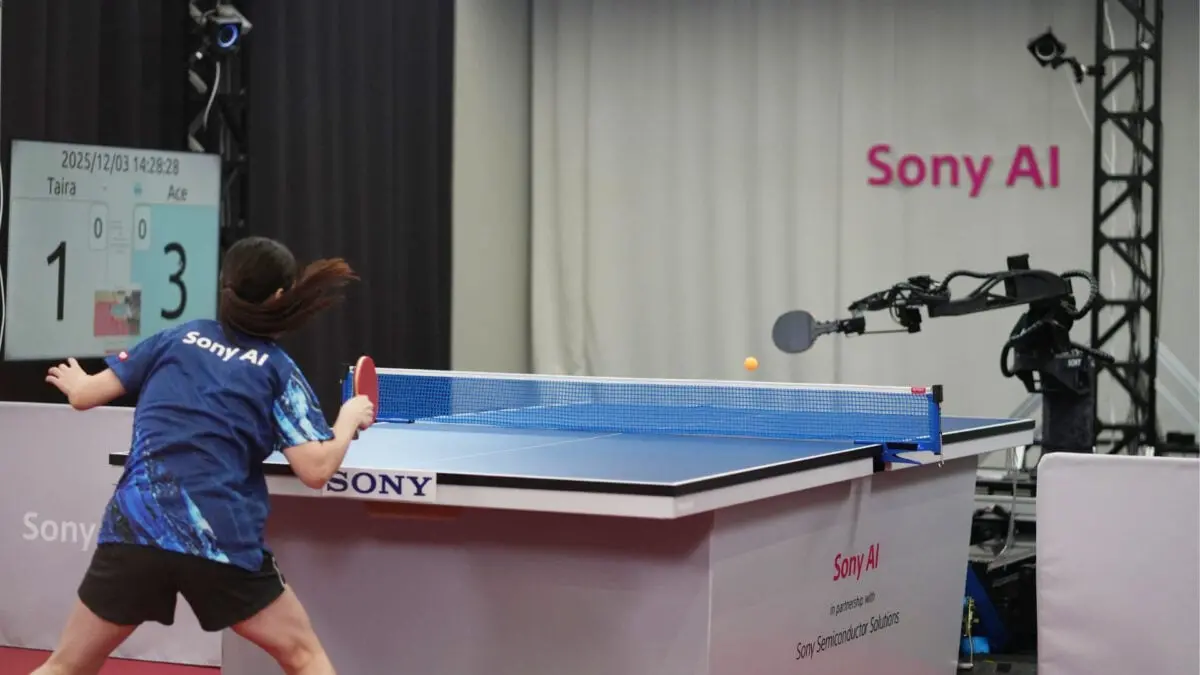
In a remarkable fusion of artificial intelligence and robotics, Sony's AI division has unveiled a robotic table tennis player named Ace that has consistently outperformed elite human competitors. Published recently in the journal Nature, the study details how Ace won the majority of its matches against players with at least a decade of experience, and even managed to secure victories against professional athletes in subsequent trials. While still falling short of the world's top-ranked players, the system represents a significant leap forward in physical AI—robots that can interact with the real world in real time with speed and precision.
The Challenge of Physical Sports AI
Table tennis, or ping-pong, might seem like a simple game to humans, but for robots it presents immense challenges. The ball travels at speeds exceeding 100 kilometers per hour, with high spins that curve unpredictably. Unlike chess or video games, where an AI can rely on perfect information from a simulated environment, table tennis requires split-second decisions based on noisy sensor data. The robot must perceive the ball's trajectory, predict its bounce, plan a return stroke, and execute it with mechanical accuracy—all within a fraction of a second. This complex interplay of perception, control, and agility has made table tennis a benchmark problem for robotics researchers since the 1980s. Early attempts were clumsy and slow, but recent advances in deep learning, high-speed cameras, and lightweight actuators have renewed interest.
Ace: Hardware and Software Innovations
Ace is not just a standard robotic arm; it is a custom-built system designed for dynamic sports interaction. The robot uses a high-resolution 3D camera system that captures the ball's position at 1,000 frames per second. This data feeds into a neural network trained on millions of simulated rallies to predict the ball's path and spin. A separate reinforcement learning algorithm decides the optimal stroke—whether to return with topspin, backspin, or a flat smash—and then commands a servo-driven actuator to swing a custom paddle. The entire decision-to-action loop takes less than 50 milliseconds, comparable to human reaction times. According to the lead researcher, the team focused on making Ace safe and adaptable. Unlike industrial robots that operate in controlled cages, Ace plays against humans in an open environment, meaning it must avoid collisions and adjust to varying playing styles.
Experiment Design and Results
To benchmark Ace's performance, the researchers followed official International Table Tennis Federation (ITTF) rules and recruited licensed umpires. In April 2025, Ace faced five elite players—defined as individuals with over 10 years of experience and 20 hours of weekly training—as well as two professional Japanese league players, Minami Ando and Kakeru Sone. Against the elite players, Ace won three out of five matches. Against the professionals, it lost both matches but managed to win one game. The results were promising enough that the team continued development. In December 2025, Ace returned for a second set of matches, where it won one of two professional games and demonstrated improved speed and edge-of-table shots. Most impressively, in March 2026, Ace defeated three professional players, including Miyuu Kihara, who at the time was ranked in the top 25 in the world for women's singles. These victories mark the first time a robot has beaten professional-level table tennis players in official match play, according to the researchers.
Historical Context and Competitors
Robotic table tennis has a long history in research labs. In the 1980s, Japanese engineers built a simple paddle-wielding arm that could return slow balls. In the 2000s, Germany's Fraunhofer Institute developed a more advanced system capable of basic rallies, but it was limited to pre-programmed shots. More recently, Chinese researchers created a robot that could play against humans, but it lacked the agility to handle fast serves. Sony's Ace surpasses these predecessors by combining state-of-the-art AI learning with a purpose-built mechanical design. Furthermore, unlike earlier systems that relied on fixed camera mounts, Ace's vision system can track the ball even when it is obscured by the net or the opponent's body, thanks to multiple synchronized cameras and predictive algorithms.
Broader Implications for Robotics
While Ace was developed primarily as a research platform, its underlying technology has potential applications far beyond the ping-pong table. The same perception and control algorithms could be adapted for industrial tasks that require rapid, precise manipulation, such as assembly line picking, drone obstacle avoidance, or surgical robots. The ability to compete against unpredictable human opponents also teaches the system to handle novel situations, a key requirement for service robots that interact with people in homes or public spaces. According to the team, the project was never intended to create a world champion; instead, it was a way to push the boundaries of physical AI. The knowledge gained from Ace's training and gameplay will inform future generations of robots that need to act quickly and safely in the physical world.
Technical Challenges Overcome
One of the hardest problems Ace had to solve was spin detection. A ball spinning at 50 revolutions per second behaves drastically differently upon bouncing compared to a non-spinning ball. The robot's neural network was trained on a massive dataset of simulated spins combined with real-world data collected from hundreds of practice matches. Additionally, the robot had to learn to vary its own spin to make returns difficult to return, a strategy that pros use to keep their opponents off balance. The researchers also fine-tuned the robot's serving ability. Unlike many earlier robots that simply pushed the ball back, Ace can generate a legal table tennis serve—with visible spin, proper toss height, and hidden wrist movement—that meets ITTF standards. This was crucial because the serve is one of the most important shots in the sport.
The robot's physical design required careful engineering. The arm and paddle are made of lightweight carbon fiber and aluminum, reducing inertia and allowing faster acceleration. The base is heavy and stable to absorb the reaction forces from powerful swings. Cooling systems prevent the motors from overheating during long matches. All of these details contributed to Ace's ability to maintain consistent performance over the course of a multi-game match.
Comparison to Human Performance
It is important to note that while Ace beat elite players and even some professionals, it has not yet competed against the very best in the world—players like the top 10 in the ITTF rankings. The researchers acknowledge that those athletes possess extraordinary quickness and tactical cunning that currently exceeds Ace's capabilities. However, the robot's win rate against professionals has been steadily increasing, and with further refinement, it may eventually challenge even the highest-ranked humans. The study also compared Ace's stroke speed and spin generation to human players. On many metrics, the robot was within 90% of human performance, and in some aspects—such as consistency of execution—it surpassed typical human reliability. This suggests that robots could excel in situations where monotony and fatigue degrade human performance.
Ethical questions also arise: if robots can beat humans at physical sports, what does that mean for the nature of competition? The researchers emphasize that Ace is a tool for understanding intelligence in the physical world, not a replacement for human athletes. Table tennis remains a human sport, but robots like Ace could serve as training partners, helping players improve by providing endless, adaptive practice sessions with precise shot repetition.
Future Directions
The Sony AI team is not stopping at table tennis. They are exploring how Ace's architecture can be transferred to other sports and real-world tasks. For example, a robot that can react as fast as a ping-pong player could also catch falling objects, assist in fast-paced manufacturing, or even help in disaster response by navigating rubble. The key is the unified pipeline of perception, prediction, and action that Ace has refined. Moreover, the research underscores the importance of simulation-to-reality transfer. The team trained Ace in millions of virtual matches before it ever picked up a real paddle, and then fine-tuned with real data. This hybrid approach drastically reduced real-world training time and is a template for other robotic learning projects. As physical AI continues to advance, the lessons from Ace will likely influence how we design robots that live and work among us.
Source: Gizmodo News