

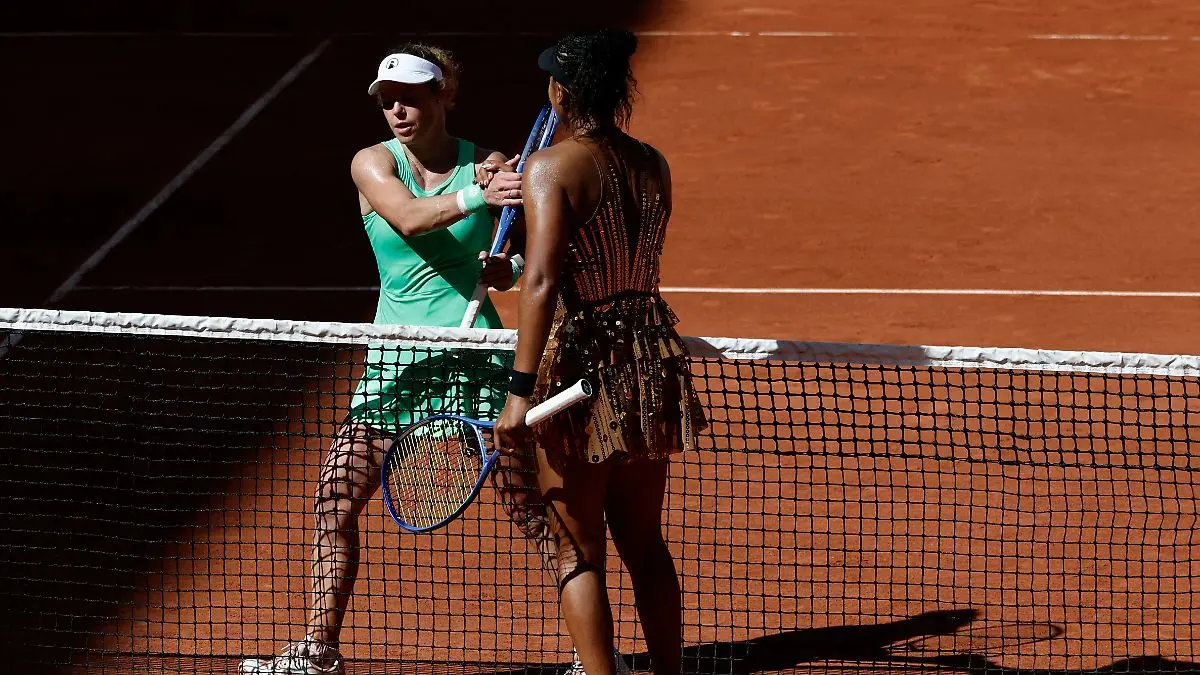
The French Open has always been a stage for dramatic encounters, but few expected the first round of the women's singles to spark a controversy about time violations and glittering dresses. Laura Siegemund, the German veteran who entered Roland Garros as the country's number one, faced a stern test against Naomi Osaka, the four-time Grand Slam champion from Japan. While the scoreline—3:6, 6:7 (3:7)—reflected a competitive match, the real drama unfolded off the court, as Siegemund openly criticized Osaka for what she considered unfair treatment by the chair umpire.
Osaka, known for her powerful baseline game and fashion-forward appearances, arrived on Court Suzanne-Lenglen in a black, floor-length glittering dress that immediately turned heads. As she prepared to start the match, she removed the dress to reveal a bronze-colored glitter outfit underneath. This pre-match routine, which included a lengthy change, did not go unnoticed by Siegemund. In her post-match interview with Eurosport, Siegemund expressed her frustration, stating that the distribution of time violations was inconsistent and favored high-profile players like Osaka.
“At every tournament, they check every second until you've unpacked your water bottle,” Siegemund said. “And she can then take another minute and a half to change clothes. That's a problem for me.” She emphasized that she came to play tennis, not to participate in a fashion show, and that if others want to do that, it's fine, but the rules should be applied equally. “The only thing that matters is the rules. When I take that long, the umpire would call a time violation. With her, he says nothing. That's what bothers me.”
The issue of time violations has been a persistent topic in tennis. The Women's Tennis Association (WTA) and the International Tennis Federation (ITF) have strict rules regarding the time allowed between points and during changeovers. The shot clock, introduced to speed up play, is intended to minimize delay. However, enforcement has often been subjective, with star players sometimes receiving more leeway. Siegemund's comments echoed similar complaints from other lower-ranked players who feel that the system is biased.
Naomi Osaka's career has been marked by both on-court brilliance and off-court activism. Born in Japan and raised in the United States, she burst onto the scene by defeating Serena Williams in the 2018 US Open final, a match that also involved a controversial time violation and a heated exchange with the umpire. Since then, Osaka has won two US Opens and two Australian Opens, becoming one of the most marketable athletes in the world. Her fashion choices have often been a topic of discussion, from wearing face masks honoring victims of racial injustice at the 2020 US Open to her dramatic entrances with parasols and veils at the Australian Open in January 2026. This year at Roland Garros, her glittering ensemble was designed by a prominent fashion house and was meant to celebrate individuality and self-expression.
Laura Siegemund, on the other hand, is a seasoned competitor known for her tactical acumen and fighting spirit. The 38-year-old German has won the singles title at the 2017 Porsche Tennis Grand Prix and has been a consistent presence on the WTA tour. She is not one to shy away from speaking her mind. In the past, she has criticized the scheduling of matches and the lack of support for older players. Her comments about Osaka were not born out of malice but from a desire for fairness in the sport she loves.
During the match itself, Siegemund came close to forcing a deciding set. After losing the first set 3-6, she battled in the second tiebreak but ultimately fell short. Osaka's power and precision were too much to handle, but Siegemund's frustration was palpable throughout. She spoke about how the umpire's leniency toward Osaka affected her concentration. “When you see that your opponent is getting away with breaking the rules, it's demoralizing,” she explained.
The chair umpire's decisions are reviewable, but there is no official challenge system for time violations. Some have called for the use of automated shot clocks that enforce strict time limits without human discretion. The WTA has experimented with stricter enforcement in some tournaments, but the issue remains contentious. Osaka's pre-match change took place before the match officially began, which might have fallen outside the strict enforcement window. However, Siegemund pointed out that similar delays by lesser-known players would likely have resulted in a warning or fine.
This incident is not the first time Osaka has been at the center of a controversy about time. During her 2018 US Open final against Serena Williams, she remained calm while Williams argued with the umpire over a coaching violation and subsequent code violations. That match became a landmark moment for discussions about sexism and rule enforcement in tennis. Now, nearly a decade later, the debate continues, albeit with a different set of characters.
Osaka herself has not directly responded to Siegemund's comments. Through her representatives, she has emphasized that she respects her fellow players and understands the competitive emotions that can arise. Her fashion choices are intended to celebrate her heritage and personality, not to distract or undermine opponents. However, the optics of a star player receiving preferential treatment, even if unintentional, can undermine the integrity of the sport.
The French Open has a long history of dramatic moments, from the legendary battles of Björn Borg and John McEnroe to the epic comebacks of Rafael Nadal. In recent years, the tournament has also become a platform for social and political statements. Osaka's glittering dress might be seen as a modern iteration of this trend, but Siegemund's critique highlights a more practical concern: the consistency of rule enforcement.
Tennis is a sport that prides itself on fairness and individual accountability. The scoreboard does not lie, but the path to each point is governed by a complex set of rules that rely on human judgment. When those judgments appear biased, the credibility of the entire competition is called into question. Siegemund's outspoken comments serve as a reminder that even in an era of advanced technology and instant replays, the human element remains both a strength and a vulnerability.
Looking ahead, the WTA may need to revisit its policies on time violations and pre-match routines. While fashion and branding are important for the growth of the sport, they should not compromise the level playing field that all athletes deserve. For now, Laura Siegemund will head back to the practice court, her dignity intact but her season at Roland Garros over. Naomi Osaka will advance to the second round, carrying both her form and the weight of expectations. The controversy over glitter and time will likely fade, but the issue of fairness will persist, as it always does in the world of professional sports.
In the broader context, this episode reflects the evolving dynamics of tennis. The sport has become more global and diverse, with players from different backgrounds bringing unique styles and personalities. Osaka represents a new generation of athletes who leverage their platform for expression, while Siegemund embodies the traditional values of discipline and strict adherence to rules. This tension is not new; it has been a part of tennis since the advent of professionalization. What is new is the intensity of the scrutiny, thanks to social media and instant news cycles.
Fans of both players have taken to various platforms to voice their opinions. Some support Siegemund's call for equal treatment, while others argue that Osaka's pre-match change was harmless and that Siegemund was looking for excuses after a loss. Regardless of where one stands, the discussion highlights the passion that tennis evokes. It is a sport where every second counts, and where perception can sometimes rival reality.
As the French Open progresses, all eyes will be on Osaka to see if she can recapture the form that made her a world number one. She has had ups and downs since taking a mental health break in 2021, but her talent remains undeniable. For Siegemund, the journey continues on the doubles court and in other tournaments. Her voice, however, will likely continue to be heard, advocating for a fairer playing field for all competitors, regardless of their ranking or fan base.
In conclusion—though the article should avoid a formal conclusion—this incident at the 2026 French Open serves as a microcosm of the challenges facing tennis today: how to balance tradition with innovation, rules with entertainment, and fairness with star power. The debate over Naomi Osaka's glittering dress and time play is far from over, and it will likely resurface at future tournaments, each time with new twists and protagonists. For now, the sport continues, resilient and ever-evolving, under the Parisian sun.
Source: ntv.de News