

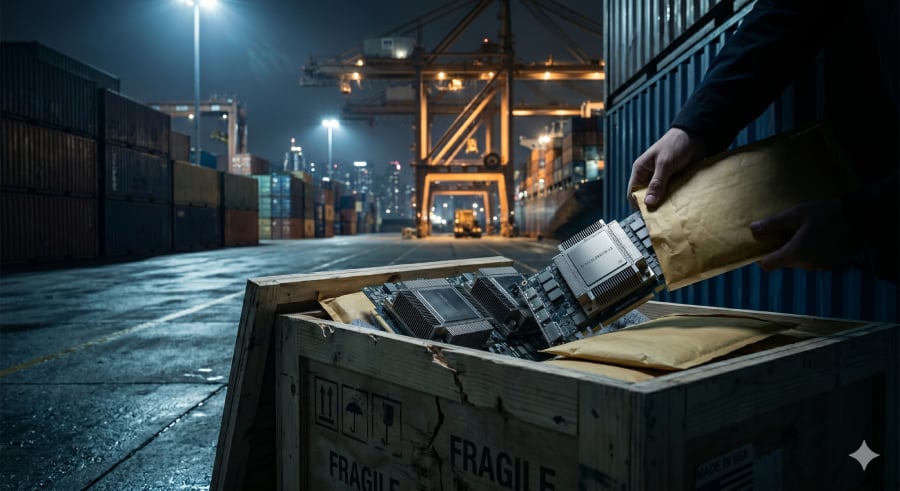
The US attempted to wall off its most advanced AI chips from rival powers, but those chips have kept finding doors. A recent court case has again alleged that brokers used encrypted messages, front companies, and third-country intermediaries to move restricted Nvidia hardware and other US technology toward banned markets despite export controls. The case exposes growing cracks in Washington's attempt to contain the spread of advanced US technologies to China and Russia.
According to a Fortune report, brokers are allegedly rerouting shipments through go-between countries, allowing high-end semiconductors from the US to quietly bypass restrictions. Officials say these chips and technology support military AI systems used by Russia in the war with Ukraine, surveillance infrastructure, cyber operations, and broader geopolitical competition between the US, China, and Russia.
How restricted AI chips allegedly reached China
Court filings from a recent case centered on Matthew Kelly, Stanley Yi Zheng, and Tommy Shad English, who prosecutors say were discussing moving banned Nvidia GPUs to China via front companies. Encrypted messages show Zheng cautioning Kelly against explicitly mentioning China in their texts, warning that it could draw the US government's attention to potential embargo violations. The conversations form part of a wider network tied to smuggling and export-control violations, though formal charges against the trio will be decided by June.
However, this particular case is just another example of mounting enforcement pressure from the Bureau of Industry and Security (BIS). Over the past year, the BIS has expanded its crackdowns on export-control violations, announcing nearly $420 million in combined penalties and forfeitures related to technology smuggling. Among the most prominent actions from the BIS was a $252 million penalty against Applied Materials for routing semiconductor equipment to China using a Korean subsidiary. Another was from Cadence Design Systems, which pleaded guilty and agreed to pay $95 million in fines.
Another notable crackdown was in a Florida case involving Hon Ning “Matthew” Ho and Cham “Tony” Li. The pair, along with two others, used a sham company to smuggle 400 Nvidia A100 chips into China through Malaysia and Thailand. In another major case, the biggest to date, Supermicro cofounder Yih-Shyan “Wally” Liaw was arrested in March for masterminding a $2.5 billion shipment of servers to China via a shell company in Southeast Asia. Although Liaw pleaded not guilty, investigations into the matter continue with Supermicro saying it received another subpoena from the SEC.
Beyond the alleged violations that have persisted because the industry is “lucrative,” according to Kelly’s WeChat conversations, US officials fear the act could have wider implications for security and AI. The pattern of smuggling reflects a sophisticated underground market where high-value chips change hands through layers of intermediaries, often using cryptocurrency and encrypted communication to evade detection. Experts note that the demand for Nvidia’s A100 and H100 GPUs in China remains extremely high, as these chips are critical for training large language models and for military applications such as autonomous systems and signal intelligence.
Why advanced chips are a security concern
According to a Ukrainian analysis cited by the US Senate, 72% of 2,797 foreign components found in Russian weapons had US origins. Highly lethal weapons like the Kh-101 missiles were among those noted in the analysis. Beyond Russia, the US export controls are also shaped by concerns over China, where access to advanced chips has become a strategic issue. Although the US has permitted some Nvidia chips into China, including its H200 recently, restricted technology has consistently flowed into China through black-market channels.
In China, these chips are used for a variety of purposes: military research, AI infrastructure, and routine products. Of all of these potential use cases, the US has consistently said it doesn’t want its technology used in Chinese military operations. The concern is not just about direct battlefield applications but also about the broader modernization of China’s People’s Liberation Army (PLA). Advanced AI chips enable faster data processing for surveillance systems, enhanced cyber warfare capabilities, and the development of autonomous drones and vehicles.
Quoting Greg Thomas, chief executive of ChainSentry, a supply chain security firm, the original report notes: “Semiconductors are the building blocks of global power in the 21st century. When an adversary or a competitor faces us on a battlefield or on the other side of a market, they need to bring their own game, not ours.” China, however, has “consistently opposed the US practice of overstretching the concept of national security and export control,” saying that “such conduct constitutes a grave violation of market economic laws and principles of fair competition.”
This tension highlights a fundamental disagreement over the legitimacy of export controls. Washington argues that they are necessary to protect national security and prevent the erosion of its technological edge. Beijing counters that they are tools of economic coercion designed to stifle its rise. The result is a cat-and-mouse game where US rules constantly evolve but smuggling networks adapt just as quickly.
Why export controls remain hard to enforce
The investigations and BIS crackdowns indicate a broader enforcement dilemma, in which the global appetite for advanced US technology has sustained diversion networks that remain difficult to fully disrupt. The cases also suggest Washington's export-control strategy is entering a harder phase. Restricting advanced AI chips is one challenge; tracking them through shell companies, subsidiaries, brokers, and third-country routes is another.
A key difficulty is the global nature of the semiconductor supply chain. Chips manufactured in the US or by US companies can be legally sold to many countries, but once they enter the secondary market, they can be re-exported to restricted destinations with little oversight. Front companies in Singapore, Malaysia, and other Southeast Asian nations are frequently used as transshipment points. The US has tried to close these loopholes by requiring end-user certificates and imposing licensing requirements, but enforcing these measures across thousands of transactions is nearly impossible without extensive intelligence sharing.
Moreover, the Biden administration and now the Trump administration have both struggled to balance the desire to control the technology with the economic interests of US companies like Nvidia, which rely on global sales. Nvidia itself has lobbied for more lenient restrictions, arguing that overly strict rules would push customers toward Chinese competitors. In fact, Nvidia has developed modified chips for the Chinese market that comply with export controls, but even these have been subject to scrutiny. The black market, however, continues to thrive because the most advanced chips offer a quantum leap in performance over the watered-down versions.
For now, the question is whether those rules can keep pace with a global market where the most restricted chips are also among the most valuable. As one former BIS official put it, “We are essentially trying to plug a leaky bucket with a thimble. The ingenuity of smugglers should never be underestimated.” The ongoing court cases and the hundreds of millions in penalties suggest that the US is serious about enforcement, but the flow of chips to China shows no sign of stopping.
Meanwhile, the geopolitical stakes continue to rise. The Ukraine war has demonstrated how critical Western technology is for Russian weapons systems. The same components that power smartphones and data centers also power missiles and drones. If the US cannot secure its supply chain, it risks arming its adversaries directly or indirectly. This is not a hypothetical risk: investigations have revealed that Russian defense firms have obtained US-made microelectronics through front companies in Europe and Asia, bypassing sanctions.
China, for its part, is investing heavily in domestic chip production, but its semiconductor industry still lags behind American and Taiwanese leaders. Until it achieves self-sufficiency, the demand for smuggled Nvidia chips will remain high. The cat-and-mouse game is likely to intensify, with both sides deploying more sophisticated techniques. The US may expand its use of sanctions against foreign companies that facilitate smuggling, while China may seek to develop alternative supply networks that are harder to trace.
What is clear is that the era of frictionless global trade in high-tech components is over. Export controls have become a central tool of strategic competition, and the battle over AI chips is only the beginning. As Greg Thomas warned, “We are in a technology cold war, and semiconductors are the currency. The country that controls the chips will control the future.”
Source: TechRepublic News