

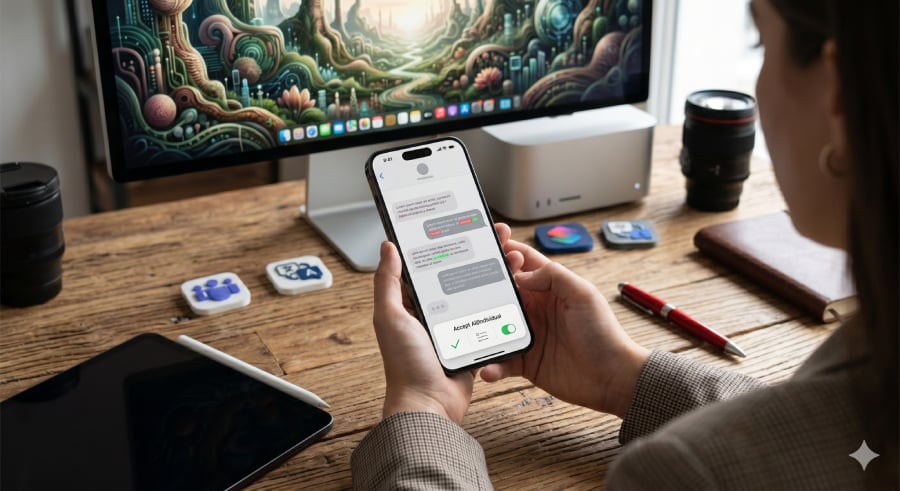
Apple may be ready to give Siri a red pen, as the tech giant is reportedly planning a Grammarly-like writing tool for the next version of Siri, one of several features expected at WWDC in June. The system would show suggested revisions at the bottom of the screen, where users could accept them individually, accept all, or reject all. It would sit alongside “Write With Siri,” a keyboard tool for generating texts, emails, and essays. If announced at WWDC, the updates would signal Apple’s next attempt to close the AI feature gap with Google and Samsung while still leaning on the privacy pitch that has long defined the iPhone.
This development comes from Bloomberg’s Mark Gurman, who also reports that users will be able to use AI to create shortcuts based on prompts detailing what they want to do. This would be a major expansion of the Shortcuts tool, which previously required the app developer to create the shortcut and get it approved by Apple for use. It follows a similar announcement by Google a few weeks ago, at the launch of Android 17, that lets users create widgets using AI prompts. Giving users the power to create their own shortcuts could potentially make the iOS experience more unique for each person by allowing them to truly personalize their home screen to maximize what they want. It will, however, depend on how much users can achieve with these prompts, as both Apple and third-party developers may want to limit how much control they can exert.
The third reveal in the report suggests Apple will let users create wallpapers for the lock and home screen using AI. Users have already been able to craft AI wallpapers in other apps and add them to the home and lock screens, but in the next version of iOS, this may be natively supported. This native integration would streamline the process, allowing users to generate unique wallpapers directly from settings without relying on third-party applications. It could also tie into Apple’s broader AI strategy, offering personalized aesthetics that adapt to user preferences or even the time of day.
Reports toward the end of last year suggested that Apple was focused on cleaning up iOS and improving performance. While that may still be happening in the background, there has been a clear shift in focus toward improving the AI feature list on iOS. Even though the iPhone maker has made some inroads through Apple Intelligence and its integration with ChatGPT, it is considered by many to be behind rivals Samsung and Google on the AI front. To that end, it has enlisted the help of its rival to build the next version of Siri, with Google Gemini as the underlying AI model. Google will reportedly receive $1 billion a year for this.
The next version of Siri will behave much more like an AI chatbot, with text alongside audio and much better contextual awareness during conversations. Users may even be able to stack multiple requests into a single command, with Siri parsing the conversation and providing answers to each request in turn. This represents a fundamental shift from Siri’s current capabilities, which are often limited to simple, single-turn queries. The integration with Gemini is expected to bring advanced reasoning and natural language understanding, enabling Siri to handle complex tasks such as drafting emails, summarizing documents, or even making travel arrangements based on contextual cues.
Apple is still keen to find ways to differentiate itself from the competition. One of those ways may be improved privacy. A report on iOS 27 indicates that Apple will let users set how long Siri keeps conversations, with a limited-memory option for privacy-focused users. Another way Apple may beat the competition is by making itself the AI kingmaker. Given its enormous iOS user base, Apple has apparently looked into a flexible approach to which AI model a user chooses, potentially creating a market where AI model makers battle it out. Similar to search, it could also rake in cash from whichever model maker pays to be the default.
This strategy mirrors Apple’s approach to search on iOS, where Google pays billions annually to remain the default search engine. By applying a similar model to AI, Apple could generate substantial revenue while offering users a choice of AI engines, such as OpenAI’s GPT-5, Google’s Gemini, or even Anthropic’s Claude. This would not only give users flexibility but also create a competitive ecosystem that drives innovation among AI providers. However, it remains to be seen whether Apple will adopt an open model or continue to favor its own in-house solutions.
The Grammarly-like writing tool for Siri is particularly significant. Grammarly has become a staple for millions of users who rely on its real-time grammar and style suggestions. Apple’s version aims to integrate deeply into the iOS experience, offering revisions directly in the Siri interface or within the keyboard. This could be especially useful in messaging apps, email clients, and note-taking tools, where users often want to polish their writing without switching contexts. The “Write With Siri” feature would go further by generating entire texts from scratch, making it a powerful tool for professionals and students alike.
These AI features are part of a broader push by Apple to catch up with competitors after a period of relative stagnation in Siri’s evolution. While Siri was a pioneer in voice assistants when it launched in 2011, it has since fallen behind Google Assistant and Amazon Alexa in terms of functionality and intelligence. Apple’s introduction of Apple Intelligence in 2024 was a step forward, but the new features at WWDC 2026 are expected to be a more comprehensive overhaul.
Another aspect of the report is the potential for AI-generated shortcuts. Shortcuts have long been a powerful tool for iOS power users, allowing them to automate tasks by chaining together actions from different apps. However, creating a shortcut often requires technical knowledge or a detailed understanding of the app’s APIs. With AI, users could simply describe what they want to do in natural language, and the system would generate a ready-made shortcut. For example, a user could say “create a shortcut that sends my work schedule to my wife every morning at 7 AM,” and the AI would build the necessary workflow. This could democratize automation, making it accessible to a much wider audience.
The AI wallpaper feature, while seemingly cosmetic, could also have deeper implications. By allowing users to generate unique wallpapers using AI, Apple may be testing the waters for broader AI-generated content capabilities, perhaps even extending to dynamic wallpapers that change based on time, weather, or activity. This could enhance the personalization of iOS, which has been a key selling point for many users.
Apple’s focus on privacy remains a consistent theme. The option to limit Siri’s memory will appeal to users who are concerned about data retention. By allowing users to set a duration for conversation history, Apple can offer the benefits of contextual awareness without compromising long-term privacy. This ‘limited-memory’ mode could be the default for new users, with the option to expand memory for those who prefer a more personalized experience.
The timeline for these features remains uncertain, but WWDC 2026 is likely to be the stage where Apple unveils its next-generation AI strategy. With the integration of Google Gemini, Apple hopes to leverage best-in-class AI while maintaining its own privacy and security standards. Whether this will be enough to close the gap with rivals remains to be seen, but it certainly represents Apple’s most ambitious AI push since the launch of Siri itself.
Source: TechRepublic News