

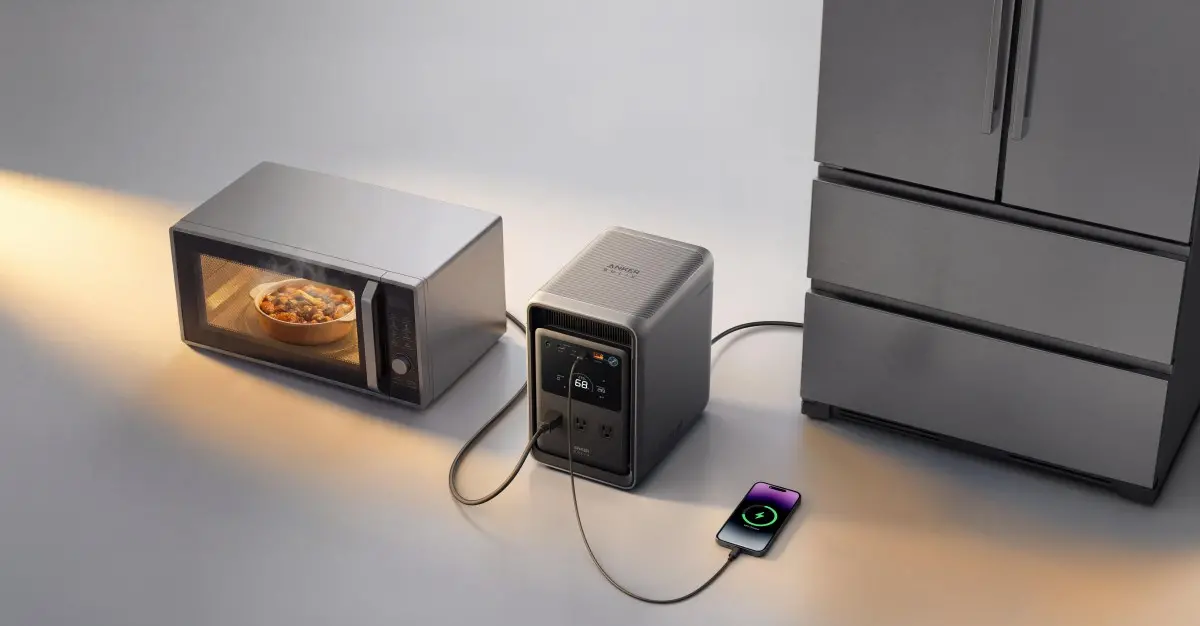
Portable power stations have become essential for van lifers, campers, remote workers, and homeowners preparing for outages. But two persistent complaints have plagued the industry: phantom power draw that silently depletes the battery when not in use, and the bulky size that makes storage difficult. Anker's latest Solix S2000 tackles both head-on, promising a 2kWh power station that stays charged longer and fits in tighter spaces.
The Problem of Idle Power Consumption
Most power stations in the 2kWh range, from brands like EcoFlow, Bluetti, and Jackery, use inverters rated at 2400W or more. These inverters, while capable of powering high-draw appliances like air conditioners or power tools, incur a significant penalty when left on. Typical idle draw exceeds 30W, meaning that if you accidentally leave the AC output running, the battery can go from full to empty in just a few days. For vanlifers who rely on their power station as a primary energy source, finding a dead battery after a weekend away can be devastating.
Anker's Solix S2000 addresses this with a technology called "OptiSave," which reduces idle consumption to just 6W. This is achieved through a combination of a lower-power 1500W inverter and smart power management circuitry. The 1500W continuous output is sufficient for most household appliances—coffee makers, water boilers, small induction cooktops, refrigerators, and CPAP machines—while still providing a 3000W peak for short surges like starting a hair dryer. The result is a power station that can maintain its charge for nearly two weeks if left idle, compared to just a few days for competitors.
Compact Design with High Energy Density
Size is the second major breakthrough. At 208 x 282 x 323 mm, the Solix S2000 packs 2kWh of LFP (lithium iron phosphate) battery capacity into a volume that yields an energy density of approximately 106 Wh per liter. That bests comparable models like the EcoFlow Delta 2 Max, Bluetti AC200L, and Jackery 2000 Plus. For van dwellers with limited space, this smaller footprint means the unit can be stowed under a bed, behind a seat, or in a cabinet without sacrificing capacity.
Weighing 35.7 pounds (16.2 kg), it is still portable enough to move between locations, though not meant for frequent carrying. The thoughtful placement of AC outlets—three on the front and two on the back—reduces the need to rotate or lift the unit when plugging in multiple devices. USB-C ports (100W max each) and a USB-A port provide modern device charging, while a 400W solar input allows off-grid recharging.
Performance and Use Cases
The 2kWh capacity is enough to run a large refrigerator/freezer combo for over a day during a power outage. For job sites, it can power tools and lighting for several hours. Its LFP chemistry offers over 3,000 charge cycles before significant degradation, meaning years of reliable service. The optional expansion batteries can increase total capacity to 4kWh, but the base unit itself is already very capable.
Anker has also focused on safety and reliability. The Solix S2000 includes a sophisticated battery management system (BMS) that monitors temperature, voltage, and current to prevent overcharging, overheating, and short circuits. It operates quietly thanks to a variable-speed fan that only kicks in under heavy loads or high ambient temperatures.
Pricing and Availability
The Solix S2000 launches at an aggressive introductory price of $599 if preordered before June 1st, making it one of the most affordable 2kWh power stations on the market. That works out to just $0.29 per watt-hour. After that, the price will rise to between $679.99 and $1,199.99 depending on retailer coupons. EU pricing and shipping dates are expected to be announced in the coming weeks.
Early reviews of the US model confirm the low idle draw and compact size, with praise for the build quality and user interface. The unit features a clear LED display showing remaining charge, input/output power, and estimated run time. A companion app (iOS/Android) provides remote monitoring and control, including scheduling timers for charging from solar panels or grid outlets.
Background: The Evolution of Portable Power Stations
The portable power station market has exploded in the last five years, driven by the rise of remote work, van life culture, and increasing concerns about grid reliability. Early models used heavy lead-acid batteries with low energy density and limited cycle life. The shift to lithium-ion and then LFP chemistry brought lighter weight, longer lifespan, and safer operation. However, manufacturers focused on increasing inverter wattage to attract customers, often at the expense of efficiency. Idle power was largely ignored until now.
Anker, known for its phone chargers and USB accessories, entered the power station market in 2022 with its Solix lineup. The company leveraged its expertise in GaN (gallium nitride) technology and power management to create more efficient inverters and charge controllers. The S2000 represents the culmination of this effort, addressing practical pain points that users have complained about for years.
Comparison with Competitors
To understand the significance of the Solix S2000, consider the EcoFlow Delta 2 Max. That unit offers 2kWh of capacity in a larger 238 x 285 x 373 mm chassis, with a 2400W inverter. Its idle consumption is listed at around 25-30W. The Bluetti AC200L has similar specs with a 2200W inverter and idle draw of about 20W. The Jackery 2000 Plus, also 2kWh, has a 2400W inverter and idle draw around 20W. None of these achieve the 6W idle of the Anker, nor do they offer as compact a footprint.
In terms of price, the Solix S2000 at its introductory $599 undercuts all of these competitors by a wide margin. The EcoFlow Delta 2 Max typically retails for $1,199, the Bluetti AC200L for $999, and the Jackery 2000 Plus for $1,199. Anker's aggressive launch pricing may force a price war in the segment, benefiting consumers.
Who Should Buy the Solix S2000?
The ideal customer is someone who needs a reliable mid-capacity power source for occasional or regular use, values space efficiency, and wants to avoid the annoyance of a dead battery after a few days of neglect. It's perfect for vanlifers who can't afford to lose power while on the road, for home backup where the unit may sit untouched for weeks until needed, and for job sites where portability and durability matter. It's less suited for those who need to run heavy AC appliances like air conditioners or large power tools continuously, as the 1500W limit may require careful load management.
The included solar input supports up to 400W, allowing reasonable charge times from solar panels. With four 100W panels in series or parallel, a full charge can be achieved in about five hours of peak sun. Anker also offers an optional 800W solar panel bundle for faster charging.
Design and Build Quality
The Solix S2000 has a sturdy plastic and metal casing with integrated handles on the sides for lifting. The front panel houses the AC outlets, USB ports, and a dedicated 12V car outlet. The rear panel has two additional AC outlets and an input port for AC charging (the included brick charges at up to 1200W, achieving a full charge in about 1.8 hours). The fan exhaust is located on the bottom, which helps keep the unit stable on a flat surface.
The display is bright and easy to read, even in sunlight, showing remaining battery percentage, input/output wattage, and estimated run time for each outlet type. Button controls allow you to turn on/off AC, DC, and USB outputs independently—a useful feature to further reduce vampire drain when only certain outputs are needed. Anker claims the idle draw remains the same even if all outputs are turned off, due to the inverter's standby circuitry.
The unit is IPX2 rated for protection against light water splashes, making it suitable for outdoor use but not heavy rain. Internal components are shock-protected, and the case is flame-retardant.
Source: The Verge News