

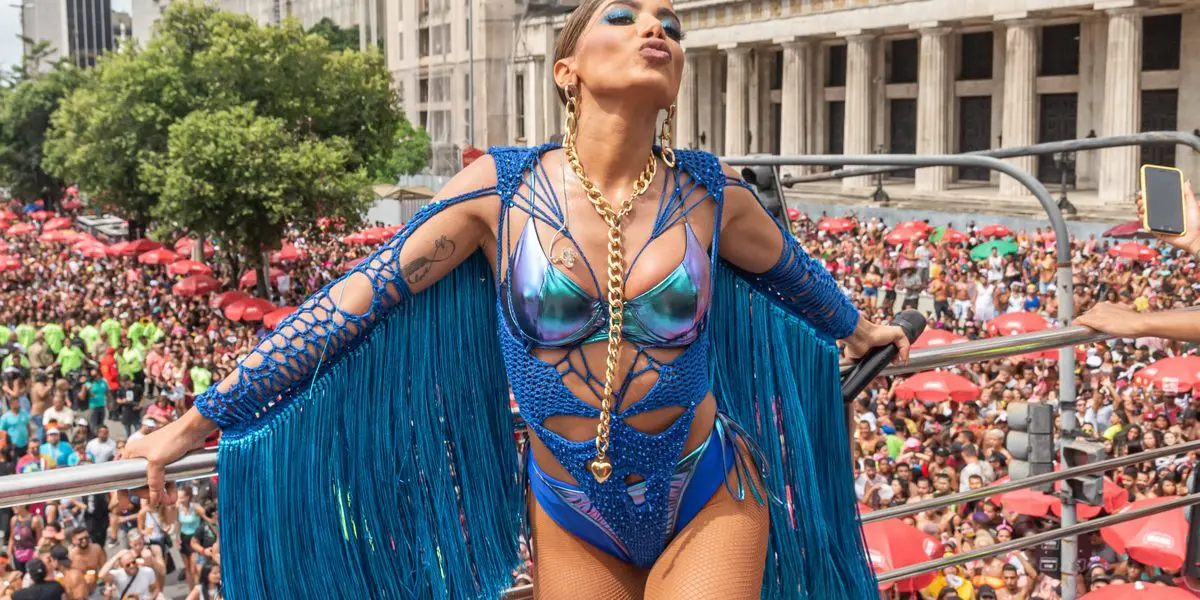
Anitta, the Brazilian pop sensation known for her provocative music videos and outspoken personality, has never shied away from controversy. Born Larissa de Macedo Machado in 1993, she grew up in the Vidigal favela of Rio de Janeiro, singing in a church choir before launching a career that would make her one of Latin America's biggest stars. Her journey is a story of ambition, resilience, and reinvention—a narrative that intersects with the complex social and political landscape of Brazil.
In a recent conversation, Anitta discussed her views on feminism, her evolving political stance, and her criticism of President Jair Bolsonaro. She also addressed the scrutiny over her extensive cosmetic surgeries and her embrace of a hypersexualized image, which she defends as an expression of personal freedom. The interview, part of a larger global affairs project, sheds light on how Anitta navigates the tensions between empowerment and commercial appeal.
From Favela to Fame
Anitta's rise is remarkable in a country where social mobility is severely limited. Her mother was a seamstress and her father sold car batteries. Growing up, Anitta had no access to formal music education, but she possessed an unshakable drive. 'If you grow up in that reality, you have no access to education, to art,' she said. 'It's hard to even develop ambition. You think it's impossible, not for people like us.' Her determination to change her family's circumstances fueled her career. She started performing in local bars and soon caught the attention of record labels. By her early twenties, she had released hit songs like 'Show das Poderosas' and 'Bang,' blending funk carioca, pop, and reggaeton.
Today, Anitta has over 50 million Instagram followers and is listed by Forbes as one of the most influential women in Brazil. Her collaborations with international artists like Cardi B and Madonna have expanded her global reach. Yet she remains acutely aware of the prejudice she faces from Brazil's middle and upper classes. 'The way they look at me—it's unreal,' she said. 'I came from a poor place with no opportunities. Those people who live in other realities don't understand how hard it is to achieve anything.'
Feminism on Her Own Terms
Anitta identifies as a feminist, but her definition is deliberately inclusive. 'For me, feminism is about freedom—everyone being who they want to be without worrying about societal expectations,' she explained. 'Women shouldn't feel they have to do anything. They only need to do what matters to them.' This philosophy informs her provocative music videos, where she often appears in bikinis or lingerie, surrounded by muscular men or riding giant bananas. Critics argue that her image objectifies women, but Anitta dismisses that view. 'If I feel good about my body and showing it, being sensual, then I do it. I'm very free,' she said. 'I would never judge women who don't like that. It makes me sad when other women judge my lifestyle.'
She acknowledges the pressure to conform to beauty standards. Early in her career, she was advised to undergo cosmetic surgery, which she embraced—altering her nose and other features. However, she now rejects being pushed to treat her cellulite. 'People tell me to get rid of it, but I don't want to,' she said. 'If someone doesn't like it, that's their problem.' This paradox of conforming to some ideals while resisting others is central to her public persona. In her song 'Girl from Rio,' a reimagining of the classic 'The Girl from Ipanema,' she celebrates the diversity of Brazilian women—their curves, tan lines, and favela roots—while critiquing the male gaze.
Political Awakening and Bolsonaro Opposition
Anitta's political journey has been equally transformative. During the 2018 presidential election, she stayed silent on the far-right candidate Jair Bolsonaro, drawing criticism from fans. She later apologized, saying she simply lacked political knowledge. 'I didn't have access to education,' she noted. 'I had to pay for my own learning.' After the election, she hired tutors to study politics and even streamed lessons on Instagram for her followers. Now she is a vocal critic of Bolsonaro, especially his handling of the COVID-19 pandemic, which has claimed over 400,000 Brazilian lives. 'If someone has the ability to prevent something but chooses not to, then I agree with the word genocide,' she stated.
She has been attacked on Twitter by Bolsonaro and his supporters, who call her a 'whore' and tell her to shut up. Undeterred, she plans to be active in the 2022 elections. 'I want my audience to be informed and understand who is electable and who isn't,' she said. 'People in Brazil need to realize that voting matters. If they elect the wrong person, it can have severe consequences for their lives immediately.'
Global Ambitions and Personal Growth
Currently based in Miami, Anitta is working on her international career. She notes that the pandemic has shifted her perspective on makeup and appearance. 'I don't wear makeup anymore during Zoom calls—just a little lipstick and powder. It feels so good,' she said. Despite her success, she remains grounded, frequently visiting her mother and friends in Brazil. Her story is not just about pop music but about the struggle for agency in a society rife with inequality. As she continues to break barriers, Anitta exemplifies how self-expression can be both a commercial strategy and a political statement.
Source: Spiegel News