

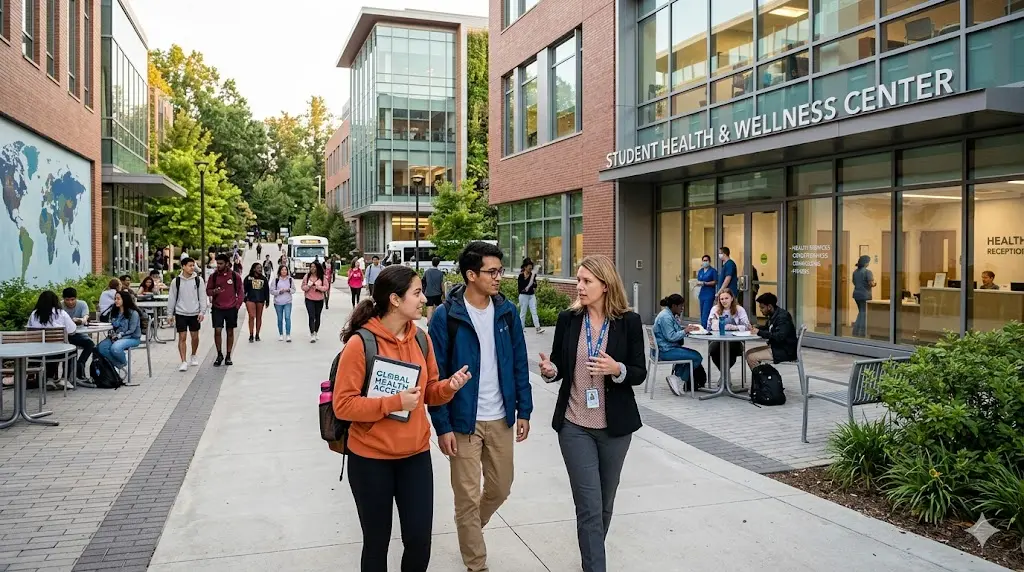
Healthcare access is no longer separate from education policy. Universities across the world are changing how they recruit students, design campuses, support mental health, and build online learning systems because healthcare access directly affects academic performance and long-term student success.
Students today don’t just choose universities based on rankings anymore. In many cases, they’re also looking at healthcare systems, insurance availability, counseling services, disability support, and overall well-being infrastructure before making enrollment decisions.
Why healthcare access is transforming higher education worldwide comes down to one major shift: student wellness now directly influences enrollment, retention, academic outcomes, and international mobility. Universities that invest in healthcare support, mental health resources, and accessible medical services are becoming more competitive globally.
What Is Healthcare Access in Higher Education?
Healthcare access in higher education refers to the availability of medical care, mental health support, wellness programs, disability accommodations, and healthcare affordability for students, faculty, and campus communities.
Healthcare Access: The ability of individuals to receive affordable, timely, and appropriate medical and mental health services when needed.
Here’s the thing. For decades, universities focused heavily on academic reputation while treating healthcare as a secondary service. That approach is changing fast.
Research increasingly shows that students struggling with untreated health issues often experience lower graduation rates, weaker academic performance, and higher dropout risks. Universities can’t ignore that anymore.
And honestly, they probably shouldn’t have ignored it in the first place.
Why Healthcare Access Matters in 2026
By 2026, healthcare support is becoming one of the strongest competitive advantages in global education systems.
What most people overlook is that international students especially pay close attention to healthcare quality before studying abroad. A university may have world-class academics, but if students fear expensive medical costs or poor mental health support, they might choose another country entirely.
That’s a huge shift.
Several institutions are now investing heavily in:
Telemedicine programs
Campus wellness centers
Mental health counseling
Emergency healthcare systems
Digital health monitoring platforms
Some universities are even partnering with hospitals and private healthcare providers to create integrated student-care ecosystems.
In my experience, this trend accelerated because students became much more health-conscious after years of global public health disruptions. People now ask practical questions that rarely came up before.
Can I afford treatment abroad?
Will counseling services be available quickly?
What happens if I get sick during exams?
Those concerns are shaping enrollment decisions worldwide.
Expert Tip
Universities trying to improve international recruitment should focus as much on healthcare transparency as academic marketing. Students and families increasingly compare wellness support before applying.
How Healthcare Access Is Reshaping Student Decisions
Students are making education choices differently now. Healthcare infrastructure has quietly become part of the decision-making process.
A student comparing universities in different countries might evaluate:
Insurance costs
Emergency medical support
Mental health accessibility
Disability accommodations
Public healthcare systems nearby
That probably sounds more like travel planning than college admissions, but that’s exactly the point. Higher education has become deeply connected to quality-of-life expectations.
Mental Health Is No Longer a Side Conversation
Mental health support has become one of the biggest drivers of institutional change.
Many universities saw dramatic increases in student anxiety, burnout, and isolation over the past several years. Waiting months for counseling appointments simply doesn’t work anymore.
Some institutions are responding well. Others still struggle badly.
I’ve noticed that students now openly discuss therapy access, stress management, and emotional support when reviewing universities online. Ten years ago, those conversations were far less visible.
That cultural shift matters.
Why International Students Care More About Healthcare Than Ever
International education is expensive already. Adding healthcare uncertainty on top of tuition costs creates major stress for families.
Students moving abroad often worry about:
Medical emergencies
Insurance limitations
Prescription access
Language barriers in hospitals
Mental health treatment availability
Universities that simplify these concerns gain a real advantage.
For example, imagine two universities offering similar academic programs. One provides affordable campus healthcare, multilingual counseling, and 24-hour telehealth access. The other offers minimal wellness support.
Most students will probably choose the safer environment.
Not because healthcare is more important than education, but because the two are now deeply connected.
How Universities Are Adapting Step by Step
Higher education institutions worldwide are redesigning policies to improve healthcare access. Here’s the process many successful universities are following.
1. Expanding Digital Healthcare Services
Telemedicine platforms allow students to access medical consultations remotely. This helps universities support both on-campus and online learners more efficiently.
It also reduces pressure on physical clinics.
2. Increasing Mental Health Investment
More universities are hiring counselors, psychologists, and wellness coordinators. Some institutions now offer free therapy sessions or peer-support networks.
That would’ve seemed unusual years ago. Now it’s becoming expected.
3. Creating Flexible Learning Policies
Students dealing with health challenges often need attendance flexibility, online access, or deadline adjustments.
Rigid systems are slowly disappearing.
4. Partnering With Healthcare Providers
Universities increasingly collaborate with hospitals, pharmacies, and insurance companies to create broader healthcare support systems.
This improves both affordability and response times.
5. Supporting Preventive Healthcare
Preventive care is becoming a bigger priority.
Instead of only responding to emergencies, universities now promote wellness education, exercise programs, nutrition awareness, and stress reduction initiatives.
And honestly, that’s probably smarter financially too. Preventive care often reduces larger healthcare costs later.
The Unexpected Link Between Healthcare and Academic Rankings
Here’s a counterintuitive point many people miss: healthcare access may eventually influence university prestige more than campus architecture or athletic facilities.
That sounds dramatic, but think about it.
Students talk constantly online about burnout, loneliness, and affordability. Universities with strong wellness systems build better reputations through student experience alone.
Word spreads quickly.
A university known for poor mental health support can damage its reputation internationally, even if its academic rankings remain high.
In my opinion, future university rankings might place far greater emphasis on wellness infrastructure than they do today.
How Online Education Changed Healthcare Expectations
Remote learning transformed student expectations around healthcare access.
Students realized they could access classes from anywhere. Naturally, they began asking why healthcare systems couldn’t become equally flexible.
That led to major growth in:
Virtual counseling
Online prescriptions
Digital therapy platforms
Remote health consultations
AI-assisted health screening tools
What most guides miss is that healthcare innovation and online education are now evolving together.
Universities that modernize one system often modernize the other too.
Expert Tip
Institutions building hybrid education models should integrate digital healthcare tools directly into student platforms. Easy access usually increases participation in wellness programs.
Common Mistake Universities Still Make
Treating Healthcare as an Optional Campus Feature
Some institutions still market healthcare services as secondary benefits instead of essential infrastructure.
That’s a mistake.
Students increasingly view healthcare access the same way they view internet access, housing safety, or library resources. It’s becoming a core expectation rather than a bonus.
Universities that fail to recognize this may struggle with retention and international recruitment.
And frankly, students notice when institutions only discuss wellness during promotional campaigns but provide limited real support afterward.
What Actually Works for Student Healthcare Support
Let me be direct. Students respond best to healthcare systems that feel accessible and human.
Long wait times, confusing insurance systems, or overly bureaucratic processes create frustration fast.
The universities handling this well tend to focus on simplicity:
Fast appointment systems
Clear communication
Affordable treatment access
Confidential mental health services
Multilingual support for international students
I’ve also seen peer-led wellness programs become surprisingly effective. Students sometimes trust conversations with trained peers more than formal institutional messaging.
That’s not something administrators always expect.
Why Governments Are Paying Attention
Governments understand that healthier students contribute to stronger economies and more stable workforces.
Higher education is increasingly connected to public health strategy.
Several countries now encourage universities to:
Expand mental health programs
Improve disability access
Increase healthcare affordability
Support remote medical systems
Strengthen crisis response planning
This relationship between healthcare and education policy will probably become even stronger over the next decade.
Especially as populations become more digitally connected and globally mobile.
People Most Asked About Why Healthcare Access Is Transforming Higher Education Worldwide
Why does healthcare access affect university enrollment?
Students and families increasingly consider healthcare affordability, mental health support, and medical safety when choosing universities, especially for international education.
How does mental health impact academic performance?
Students dealing with untreated stress, anxiety, or depression often experience lower concentration, attendance problems, and reduced academic outcomes.
Are universities investing more in healthcare services?
Yes. Many institutions are expanding counseling centers, telemedicine systems, wellness programs, and partnerships with healthcare providers.
Why do international students prioritize healthcare access?
Studying abroad can create uncertainty around medical costs, insurance coverage, and emergency support. Reliable healthcare systems reduce those concerns significantly.
What role does technology play in student healthcare?
Technology supports telehealth appointments, online therapy, health monitoring apps, digital prescriptions, and remote wellness services for students.
Can healthcare quality influence university rankings?
Indirectly, yes. Strong student wellness systems improve retention, satisfaction, reputation, and overall campus experience.
What challenges still exist in higher education healthcare?
Common challenges include long counseling wait times, affordability concerns, unequal access, staffing shortages, and balancing digital privacy with healthcare technology.
Final Thoughts on Why Healthcare Access Is Transforming Higher Education Worldwide
Why healthcare access is transforming higher education worldwide comes down to one reality: students can’t succeed academically if their physical and mental well-being are constantly under pressure.
Universities are slowly realizing that healthcare support isn’t separate from education quality. It’s part of it.
Some institutions are adapting quickly with flexible healthcare systems, digital wellness tools, and stronger mental health investment. Others are still catching up.
Either way, the future of higher education will probably depend not only on what students learn, but also on how well universities help them stay healthy while learning it.
Businesses aiming to strengthen brand visibility and organic traffic can benefit from press release distribution services alongside strategic local SEO services that help generate high authority backlinks, better SEO ranking, wider media coverage, and instant publishing opportunities for agencies, startups, and growing brands.