

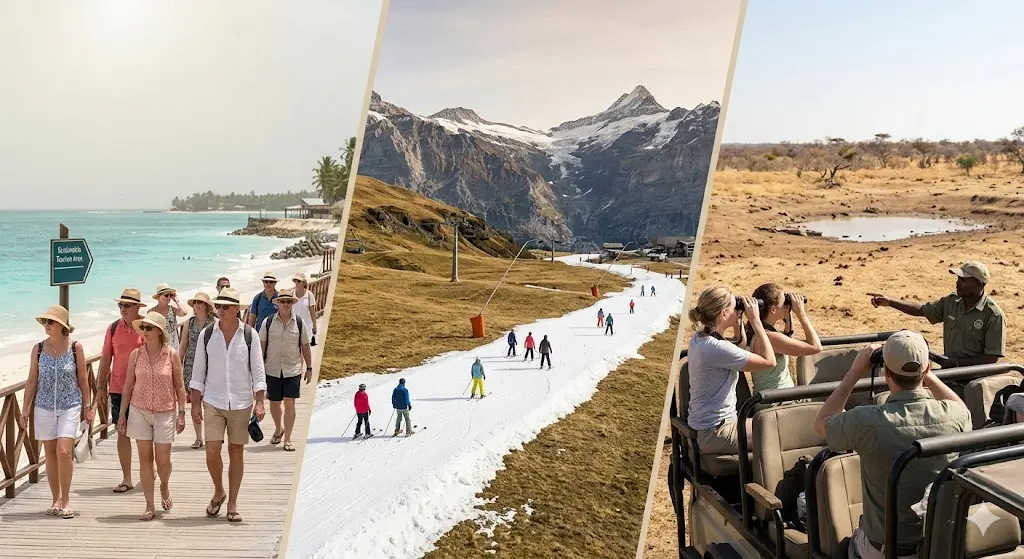
Climate change is no longer something the tourism industry talks about in the background. It is actively reshaping where people travel, how they travel, and even why they choose certain destinations over others. If you’ve noticed shifting travel seasons or rising interest in cooler regions, that’s not random. It’s a direct response to environmental pressure.
In simple terms, global tourism trends related to climate change reflect how travelers and the travel industry are adapting to extreme weather, environmental awareness, and long-term sustainability concerns. And honestly, this shift is already rewriting the rules of global tourism faster than most people expected.
Tourism is being reshaped by climate change through shifting travel seasons, growing demand for eco-conscious travel, and destination changes driven by weather risks. Travelers are adjusting behavior, while destinations are redesigning tourism models to survive environmental uncertainty.
What Are Global Tourism Trends Related to Climate Change?
Climate-related tourism trends refer to changes in travel behavior, destination planning, and tourism infrastructure driven by environmental shifts such as rising temperatures, extreme weather, and ecological degradation.
Here’s the thing. Tourism used to be predictable. Summer holidays meant beaches, winter meant mountains, and everything in between followed a fairly stable rhythm. That rhythm is breaking apart.
You now see travelers avoiding destinations during peak heat waves or flooding seasons. At the same time, previously “off-season” locations are becoming surprisingly popular because they offer milder conditions. I’ve seen this shift firsthand in conversations with frequent travelers who now check weather stability before they even look at prices.
What most people overlook is that tourism isn’t just reacting to climate change—it is slowly reorganizing itself around it.
Why Global Tourism Trends Related to Climate Change Matter in 2026
By 2026, climate uncertainty is no longer an occasional disruption. It is part of travel planning. Airlines, hotels, and even local tourism boards are redesigning their strategies based on environmental patterns that didn’t matter as much a decade ago.
Let me be direct. Travelers are becoming more cautious. Not necessarily because they are environmentally strict, but because extreme weather has made unpredictability expensive and inconvenient.
In my experience, one of the biggest shifts is psychological. People don’t just ask “Where do I want to go?” anymore. They also ask “Will this place still be comfortable when I get there?”
There’s also a quiet competition forming between destinations. Some are gaining popularity simply because they are cooler, less crowded, or less exposed to climate risks. Others are struggling to maintain tourism flow.
And here’s something unexpected: climate concern is not always about ethics. Sometimes it’s just practicality disguised as awareness.
How Tourism Is Adapting to Climate Change — Step by Step
Step 1: Redefining travel seasons
Traditional peak seasons are becoming less reliable. Tourism boards are adjusting calendars based on temperature patterns rather than historical trends.
Step 2: Designing climate-resilient infrastructure
Hotels and resorts are shifting construction styles to handle heat, flooding, and energy demands. This isn’t just about sustainability—it’s about survival in extreme conditions.
Step 3: Adjusting destination marketing
Destinations are quietly repositioning themselves. Places once promoted for summer travel are now focusing on shoulder seasons or cooler months.
Step 4: Encouraging low-impact travel options
Transport systems and tourism providers are promoting slower, lower-impact travel experiences. Not everyone loves this change, but it’s becoming more common.
Step 5: Using predictive environmental data
Tourism operators now rely on climate forecasting tools to anticipate risks and adjust pricing, availability, and recommendations.
Common Misconception: Eco-tourism is always the solution
A lot of people assume eco-tourism alone can fix climate-related tourism problems. That’s not really accurate.
Eco-tourism helps reduce impact, sure. But it doesn’t solve larger structural issues like destination vulnerability or shifting weather zones. I’ve seen places heavily invested in “green branding” still struggle because they ignored infrastructure resilience.
So while eco-friendly travel matters, it’s only one piece of a much larger puzzle.
Expert Insights: What Actually Shapes Climate Tourism Trends
Expert tip: One of the most misunderstood aspects of climate-driven tourism change is timing. Many destinations wait until damage is visible before acting. By then, recovery becomes expensive and slow. The smarter approach is anticipating climate shifts years in advance and adjusting tourism models early.
Expert tip: Another overlooked factor is traveler psychology. People don’t always respond logically to climate risks. A destination can have real environmental challenges but still remain popular if its perception stays strong.
From what I’ve observed, destinations that combine honest communication with practical adaptation strategies tend to maintain trust better than those trying to “market away” climate issues.
Here’s a personal take: I think tourism will eventually split into two experiences. One will be highly climate-controlled and predictable. The other will be more raw, seasonal, and weather-dependent. And honestly, both will have their own audience.
What most people miss is that climate change doesn’t just reduce tourism—it redistributes it.
Real-World Scenarios Showing Climate-Driven Tourism Change
One example that stands out involves a coastal destination that traditionally relied on summer tourism. As temperatures began rising beyond comfortable levels, visitor numbers dropped during peak months. Interestingly, the same destination started seeing more visitors during early spring and late autumn, when conditions were milder.
Another case involves mountainous regions that were once considered off-season in winter due to snowfall unpredictability. As weather patterns shifted, these regions began attracting visitors seeking cooler air and stable conditions during hotter months elsewhere.
I remember speaking with a small tour operator who told me something that stuck with me. He said, “We don’t sell seasons anymore. We sell comfort windows.” That phrase says a lot about where tourism is heading.
Why Climate Change Is Reshaping Traveler Behavior
Travelers are becoming more selective, but not always in the way people assume. It’s not just about avoiding harm to the environment. It’s also about avoiding discomfort, risk, and wasted time.
People now check multiple environmental factors before booking, even if they don’t consciously label it as climate awareness. Heat intensity, rainfall unpredictability, and air quality all quietly influence decisions.
There’s also a subtle emotional shift. Travel is no longer just escape. It is becoming negotiation with environmental reality.
And here’s something counterintuitive. Some destinations are actually benefiting from climate change because they offer more stable or comfortable conditions compared to traditional hotspots.
That shift is reshaping global tourism maps in ways we’re only beginning to understand.
People Most Asked about Global Tourism Trends Related to Climate Change
How does climate change affect travel destinations?
Climate change alters weather patterns, making some destinations less predictable and others more attractive. Rising temperatures, flooding risks, and seasonal instability all influence visitor behavior.
What is sustainable tourism in relation to climate change?
Sustainable tourism focuses on reducing environmental impact while supporting local economies. It encourages responsible travel choices that minimize damage to ecosystems and communities.
Why are travel seasons changing globally?
Travel seasons are shifting because traditional weather patterns are no longer stable. Heatwaves, rainfall changes, and unpredictable seasonal cycles are pushing travelers to adjust timing.
Are tourists becoming more environmentally conscious?
Yes, but not always for purely ethical reasons. Many travelers adjust behavior due to comfort, cost, and safety concerns linked to environmental changes.
Which regions are most affected by climate tourism shifts?
Coastal and tropical regions are often the most affected due to rising temperatures and extreme weather. However, cooler regions are also seeing increased demand.
Global tourism trends related to climate change are reshaping how the entire travel system functions. From shifting seasons to evolving traveler expectations, climate patterns are no longer background conditions—they are active forces shaping decisions.
What stands out most is how quietly this transformation is happening. Travelers adjust without always realizing why, and destinations respond in ways that slowly redraw global tourism patterns. In many ways, the future of travel is no longer just about where people want to go, but where the planet still comfortably allows them to go.
Our Network site provide related offering Guest Posting Services and Press Release News Submission, helping businesses strengthen brand visibility and organic traffic through high authority backlinks and SEO ranking improvements. Platforms like press release distribution services and digital marketing services support instant publishing, media coverage, and scalable link building services designed for startups, agencies, and bloggers aiming for stronger online growth and trust signals.