

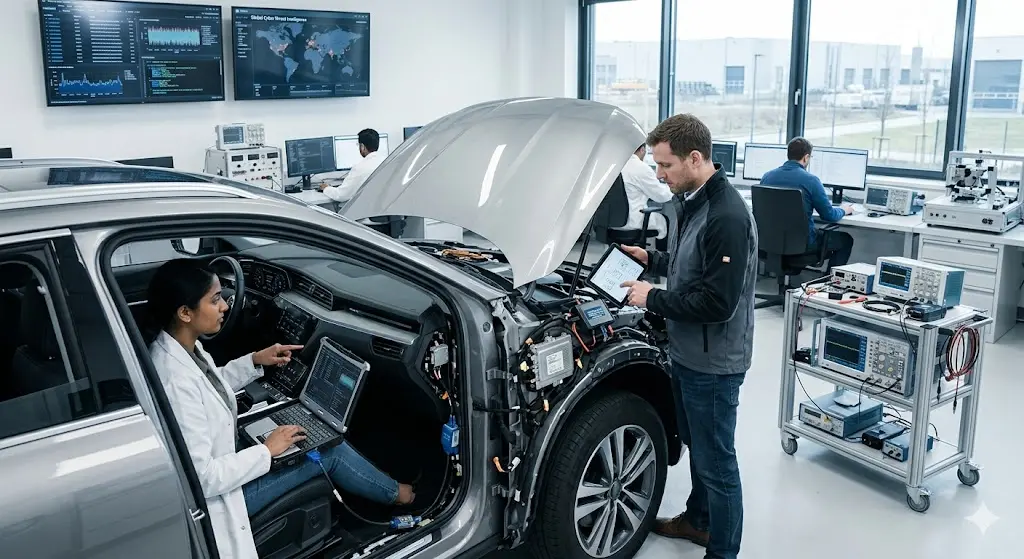
Cybersecurity in the automotive industry is no longer a side conversation about “future risk.” It’s already shaping how vehicles are designed, connected, and updated. As cars become more like rolling computers, global research on cybersecurity in the automotive industry shows a clear pattern: attackers are getting smarter, and vehicles are becoming more exposed through connectivity, software updates, and third-party integrations.
Here’s the thing most people miss. It’s not just luxury electric vehicles that are at risk. Even mid-range connected cars today carry enough digital complexity to be probed, manipulated, or disrupted if security isn’t treated as a core engineering priority.
Global research on cybersecurity in the automotive industry focuses on protecting connected vehicles from hacking, data theft, and system manipulation. It combines secure software design, encrypted communication, and real-time threat monitoring. As vehicles become more autonomous and connected, cybersecurity is now a core safety requirement, not just an IT concern.
What Is Global Research on Cybersecurity in the Automotive Industry?
Automotive cybersecurity is the practice of protecting vehicles, onboard systems, and connected infrastructure from digital attacks.
In simple terms, it means making sure no one can remotely take control of your car, steal your driving data, or mess with critical systems like braking, steering, or navigation.
Global research in this area goes beyond theory. It looks at real-world vulnerabilities in connected vehicles, electric platforms, and autonomous driving systems. Researchers study how attackers exploit wireless interfaces, infotainment systems, mobile apps, and even charging stations.
In my experience, what makes this field tricky is that cars aren’t static systems like laptops. They move, they connect to multiple networks, and they depend on dozens of suppliers. That creates far more entry points than most engineers expect at first glance.
Connected Vehicle Security: The protection of internet-enabled vehicles from cyber threats targeting communication systems, sensors, and onboard software.
Why Global Research on Cybersecurity in the Automotive Industry Matters in 2026
By 2026, the automotive ecosystem is deeply connected. Vehicles talk to cloud servers, mobile apps, smart traffic systems, and even other vehicles. That level of interconnection is powerful, but it also opens doors.
What most people overlook is how quickly software has replaced mechanical control systems. A modern car may contain over 100 million lines of code. That’s more than some operating systems. And more code usually means more bugs, and more bugs often mean more vulnerabilities.
Global research highlights three major pressure points: autonomous driving systems, over-the-air updates, and vehicle-to-everything communication. Each of these introduces a digital doorway that needs constant protection.
I’ve seen discussions in engineering circles where teams assume encryption alone is enough. It usually isn’t. Attackers often bypass encryption entirely by targeting weak APIs or outdated firmware instead.
A well-known real-world example involved researchers demonstrating remote access to vehicle systems through infotainment vulnerabilities. It wasn’t a fantasy scenario; it showed how entertainment systems can become unexpected entry points into critical driving controls.
External reference insights from organizations like ISO/SAE 21434 cybersecurity standard overview and NHTSA vehicle cybersecurity guidance highlight how regulators are now pushing manufacturers toward structured cybersecurity engineering practices.
Expert Tip
One thing engineers quietly admit is that “secure by design” often fails when suppliers don’t follow the same standards. You might secure your main system well, but a weak third-party module can still bring everything down.
How to Secure Automotive Systems Step by Step
Securing automotive systems isn’t a one-time setup. It’s a layered process that evolves with the vehicle lifecycle.
Step 1: Identify every digital entry point
You start by mapping everything that connects to the vehicle. This includes Bluetooth, Wi-Fi, USB interfaces, mobile apps, and even diagnostic ports. The goal is simple: nothing should be invisible.
Step 2: Secure software architecture early
Security can’t be added later like an accessory. It has to be part of the architecture from the beginning. This includes segmentation of critical systems like braking and steering from entertainment systems.
Step 3: Encrypt communication channels
All data flowing between the vehicle and external systems must be encrypted. But encryption alone isn’t enough if authentication is weak.
Step 4: Implement real-time monitoring
Modern vehicles need continuous threat detection systems that can identify unusual behavior patterns. If something behaves strangely, the system should respond instantly.
Step 5: Enable secure over-the-air updates
Updates are essential, but they must be verified, signed, and protected from tampering. Otherwise, update channels become attack routes.
Let me be direct here. Many manufacturers still treat cybersecurity as a compliance checkbox instead of an ongoing process. That mindset is slowly changing, but not fast enough.
Common Misconception: “Cars are safe because they’re isolated”
This assumption is outdated. Most modern vehicles are never truly isolated. Even if they’re not connected to the internet directly, they connect through phones, service tools, and dealership systems. That indirect connectivity is often enough for exploitation if weak points exist.
Expert Insights on Automotive Cybersecurity Research
In global automotive cybersecurity research, one consistent finding stands out: attackers don’t usually go for the hardest target. They go for the weakest connected component.
In one simulated research scenario, a compromised mobile app allowed indirect access to vehicle telemetry. It didn’t require breaking encryption at the vehicle level. Instead, it exploited weak authentication on the cloud layer. That’s the kind of detail many people underestimate.
Here’s my honest take. Most security models still think in terms of perimeter defense, but vehicles don’t have a clean perimeter anymore. They are distributed systems moving through multiple digital environments.
Another overlooked point is timing. Attackers don’t always act immediately. Sometimes they collect data silently for months before triggering an exploit. That delayed attack pattern is especially dangerous in automotive systems.
Expert Tip
If you’re designing or evaluating vehicle systems, assume compromise will happen at some point. The real question is how fast you detect it and how well you isolate it.
People Most Asked About Global Research on Cybersecurity in the Automotive Industry
What are the biggest threats in automotive cybersecurity today?
The most common threats include remote hacking attempts, ransomware targeting vehicle fleets, and manipulation of onboard sensors. These risks grow as vehicles become more connected.
How does vehicle-to-everything communication affect security?
It expands the attack surface significantly. While it improves traffic flow and safety systems, it also creates new digital pathways that must be secured individually.
Why is automotive cybersecurity harder than traditional IT security?
Vehicles combine hardware, software, and real-world motion. Unlike static systems, they operate in unpredictable environments and depend on multiple suppliers and communication layers.
Can electric vehicles be hacked more easily?
Not necessarily, but their heavy reliance on software updates and connectivity means they have more potential entry points if not properly secured.
What role do regulations play in this field?
Regulations are becoming stricter globally, pushing manufacturers to adopt standardized cybersecurity frameworks and continuous monitoring practices.
Is autonomous driving more vulnerable to cyber threats?
Yes, because it relies heavily on sensors, AI decision-making, and constant data exchange. Any disruption in that chain can have serious safety consequences.
How do manufacturers test cybersecurity in vehicles?
They use penetration testing, simulation environments, and controlled hacking exercises to identify weaknesses before vehicles reach production.
Expert Tips / What Actually Works
One thing that consistently works in automotive cybersecurity is layered defense. Not just one security wall, but multiple overlapping protections that slow attackers down.
Another practical approach is “zero trust thinking.” It sounds abstract, but in real terms it means no system or device is automatically trusted, even inside the vehicle network.
From what I’ve seen, companies that involve security teams early in the design phase tend to have fewer emergency patches later. It sounds obvious, but it still doesn’t happen as often as it should.
Counterintuitive Insight
Here’s something that surprises many people. The most secure-looking system can sometimes be the most fragile. Why? Because it gives a false sense of confidence, leading teams to skip deeper testing. Real-world cybersecurity often breaks in unexpected places, not the obvious ones.
Final Thoughts
Global research on cybersecurity in the automotive industry is no longer just about preventing hacks. It’s about preserving trust in transportation systems that are becoming increasingly software-defined. As vehicles continue to evolve, security will quietly decide how safe and reliable mobility really is.
If there’s one takeaway, it’s this: cybersecurity in cars isn’t a feature anymore. It’s part of the engine.
If you want stronger digital authority and wider reach for cybersecurity or automotive research content, our Network site provides Guest Posting Services and Press Release News Submission designed to improve brand visibility and SEO ranking across competitive industries. With trusted publishing support on platforms like press release distribution services and digital marketing services, businesses can achieve high authority backlinks, better organic traffic, and instant publishing exposure. It’s a practical way to build credibility while expanding media coverage across global audiences.